
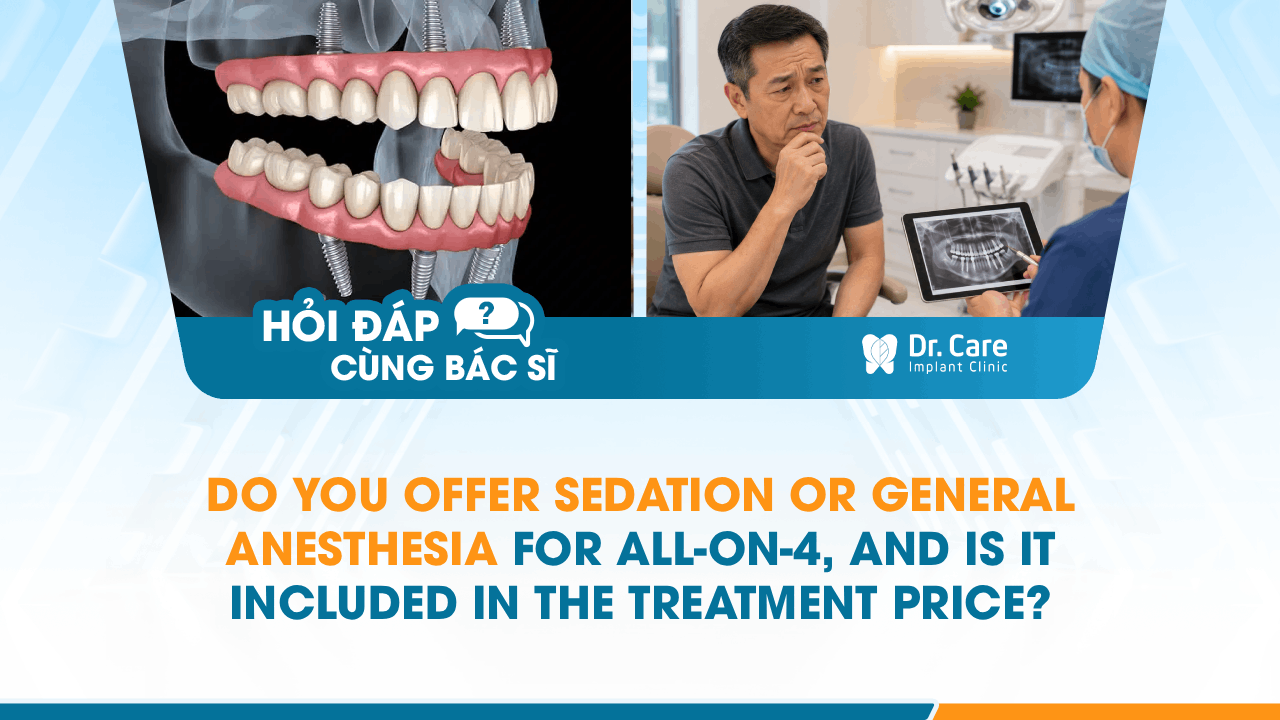
Kevin Lam, 59, has significant dental anxiety and is considering All-on-4 treatment in Vietnam. Most All-on-4 procedures at Dr. Care can be performed with local anesthesia, while premedication or sedation may be considered when anxiety is severe, the procedure is prolonged, or the patient has difficulty cooperating. General anesthesia is not routinely required and should only be considered after medical and airway assessment in an appropriately equipped setting with an anesthesia team. Dr. Care’s published All-on-4 price should not be assumed to include sedation or general anesthesia; if these are clinically indicated, the additional anesthesia-related costs should be itemized before treatment.
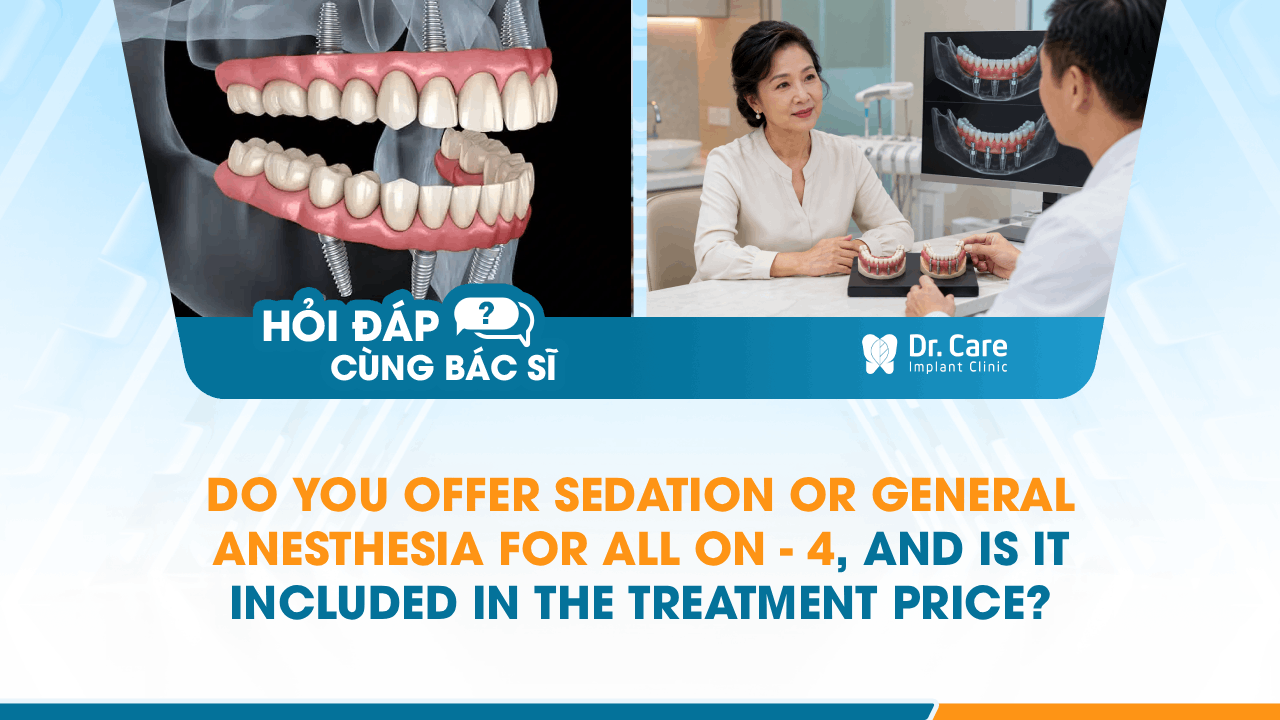
[HỎI ĐÁP BÁC SĨ]: All-on-4 or All-on-6 for a Completely Edentulous Lower Jaw—Is Six Actually Stronger?
Emily Hoang, 56, has lost all of her lower teeth and is comparing All-on-4 with All-on-6. Both approaches can provide predictable fixed full-arch rehabilitation in the mandible when correctly planned. Six implants can offer additional support and redundancy in selected patients, but current evidence does not show that All-on-6 is automatically more durable than a properly designed All-on-4. The decision should be based on mandibular bone distribution, implant positions, cantilever length, bite force, opposing dentition, bruxism, hygiene access and the final prosthetic design.
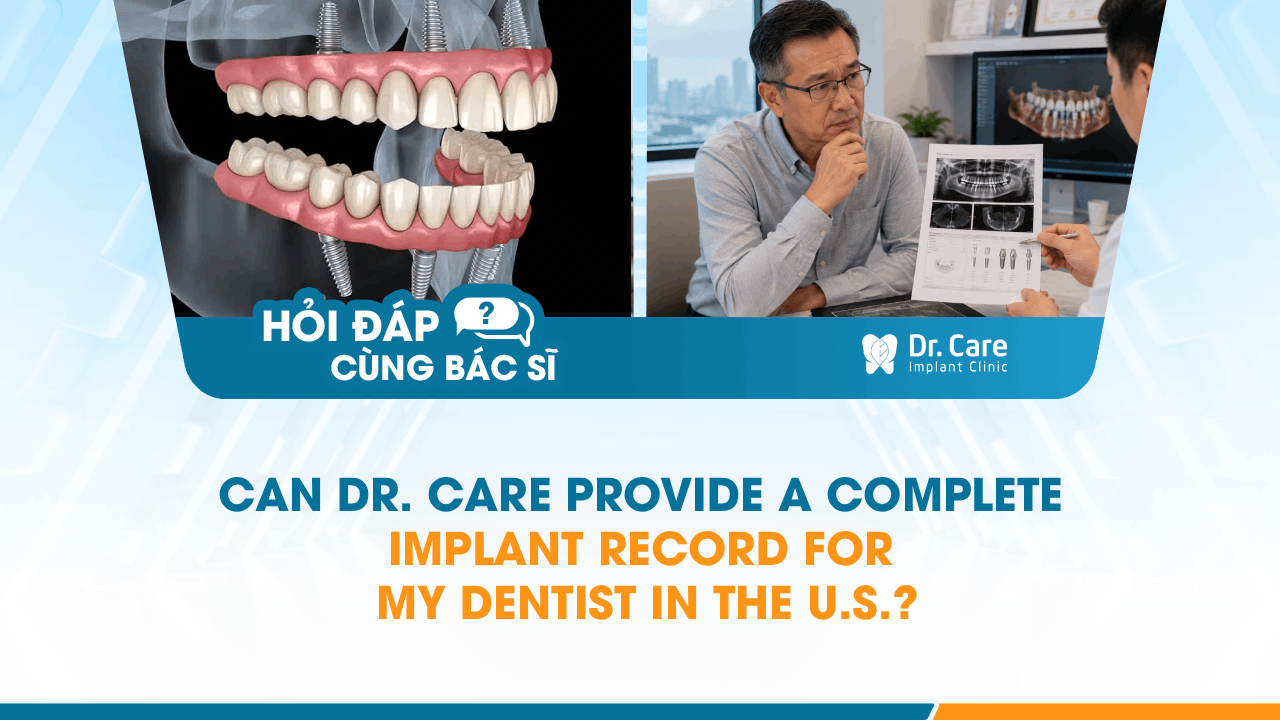
[HỎI ĐÁP BÁC SĨ]: Can Dr. Care Provide a Complete Implant Record for My Dentist in the U.S.?
Richard Doan, 64, wants his U.S. dentist to have a complete record after Implant treatment in Vietnam. Dr. Care’s current workflow allows patients to take home X-rays, the treatment plan and Implant information, and the clinic has also documented that an international-patient handover package can include the treatment summary, Implant brand and dimensions, Implant positions, available CBCT/radiograph files, clinical photographs, surgical notes, postoperative instructions, medication history and follow-up timeline. For full-arch treatment, Richard should additionally request the exact restorative connection, multi-unit abutment specifications, prosthetic design and baseline imaging so a future U.S. Implant dentist does not have to identify the system from an X-ray alone.
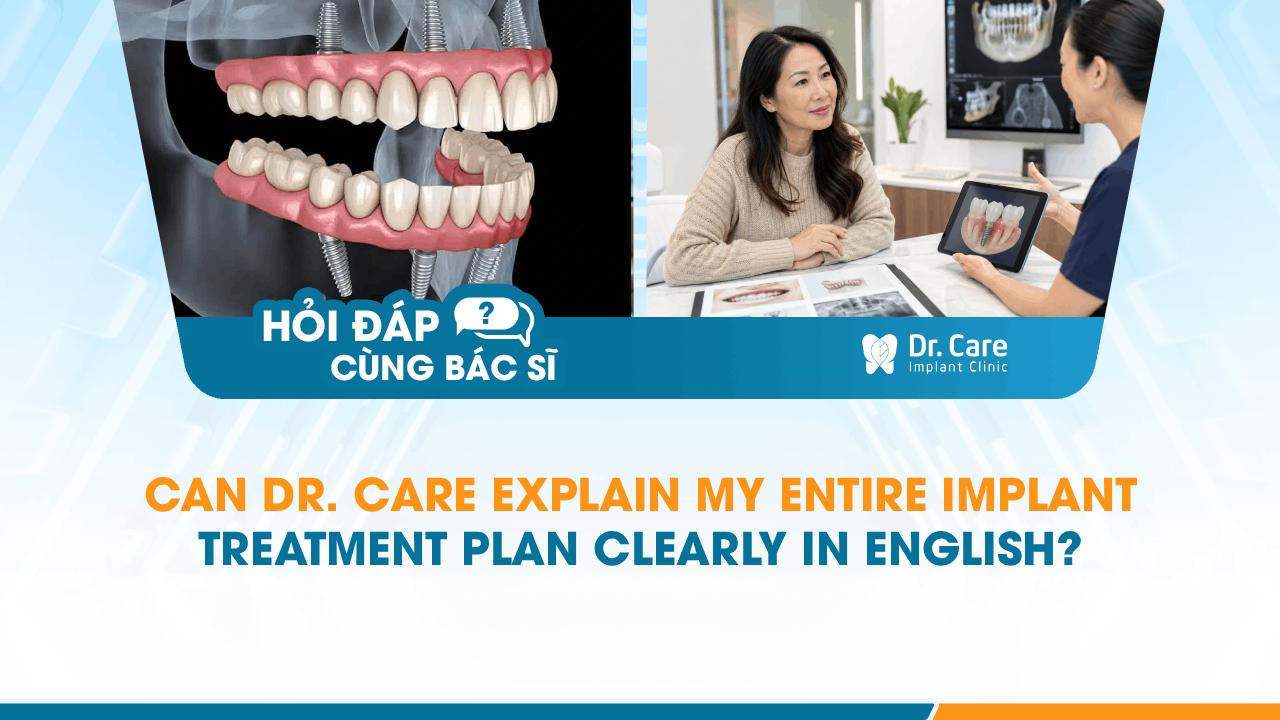
[HỎI ĐÁP BÁC SĨ]: Can Dr. Care Explain My Entire Implant Treatment Plan Clearly in English?
Mai Truong, 45, grew up in Canada and is no longer fully comfortable discussing complex medical and dental information in Vietnamese. Dr. Care currently provides English consultation support and can prepare treatment documentation in English for international patients. However, Mai should request English-language support when booking rather than assume every staff member has the same level of fluency. Before consenting to Implant treatment, she should be able to understand her CBCT findings, treatment alternatives, Implant system, surgical risks, provisional and final prosthetic stages, costs, healing timeline, follow-up requirements and contingency plans entirely in the language she is most comfortable using.
[HỎI ĐÁP BÁC SĨ]: How Can I Verify That Dr. Care and Its Implant Surgeons Are Properly Licensed Before Traveling from London?
George Phan, 62, wants to independently verify a Vietnamese Implant clinic before committing to international travel. Dr. Care’s operating license can be cross-checked against the Ho Chi Minh City Department of Health public records: the dental clinic is listed under license No. 05791/HCM-GPHĐ, originally issued on April 27, 2018. Surgeon credentials should be checked separately by obtaining the exact treating dentist’s full name, professional practice-license number, permitted dental scope and Implant training credentials. Professional memberships, manufacturer courses and marketing awards can support a clinician’s profile, but they are not substitutes for a valid clinic license or individual professional authorization.
[HỎI ĐÁP BÁC SĨ]: After 20 Years Without Back Teeth, Will I Need a Bone Graft Before Dental Implants—and How Much Longer Could Treatment Take?
Christine Ly, 53, has been missing posterior teeth for more than 20 years and is concerned about jawbone loss. Long-standing tooth loss makes ridge resorption more likely, but it does not automatically mean bone grafting is required. CBCT imaging is needed to measure the remaining bone and, in the upper jaw, assess the maxillary sinus. If only a small graft can be performed at the same time as Implant placement, the number of major Vietnam trips may not change. If substantial ridge reconstruction or a staged sinus lift is required before Implant placement, treatment can add several months and potentially an additional trip.
[HỎI ĐÁP BÁC SĨ]: Is It Better to Stay in Vietnam for Two Months After Implant Surgery or Split Treatment Into Two Trips?
Daniel Huynh, 68, is retired and can remain in Vietnam for up to two months. A longer first stay can be convenient for wound checks, provisional-tooth adjustments and management of early complications, but remaining in Vietnam for eight weeks does not make the implants osseointegrate faster simply because the patient stays near the clinic. For most uncomplicated full-arch cases, the more practical plan is still two treatment phases: surgery and provisional fixed teeth during the first trip, then approximately 4–6 months of biological healing before returning for the definitive prosthesis.